











Two deeply human biases, our discomfort with the unknown and our preference for measurable wins, systematically push organizations toward cost reduction. Safety feels responsible, and efficiency gains are easy to quantify on a spreadsheet. In contrast, top-line growth from AI exploration is messy, nonlinear, and hard to attribute to quarterly metrics.
Over time, these biases harden into a shared set of assumptions so fundamental that practitioners stop seeing them as choices:
- Variability is risk. Reduce it everywhere.
- Consistency is quality. Optimize for reproducibility.
- Control is governance. Approval gates protect value.
- AI success means AI predictability. Measure it by how consistently it behaves.
As a result, we default to building “storm shelters” everywhere, optimizing for control even where variability is essential for creating new value. Walk into any AI strategy session and you’ll hear the same narrative: efficiency gains, productivity improvements, cost takeout. We want breakthrough thinking, but we optimize for reproducibility.
Here is what this means in practice: the dominant operating assumptions actively suppress the growth opportunities organizations adopted AI to find. Growth requires the very variability the control architecture is designed to eliminate. This is not an execution failure. It is an architectural constraint built into the assumptions themselves.
From uniform control to architectural intent
The shift we are proposing is not incremental. It is a genuine reorientation in how leaders think about AI’s relationship to value. And like all deep shifts, it requires abandoning beliefs that feel foundational:
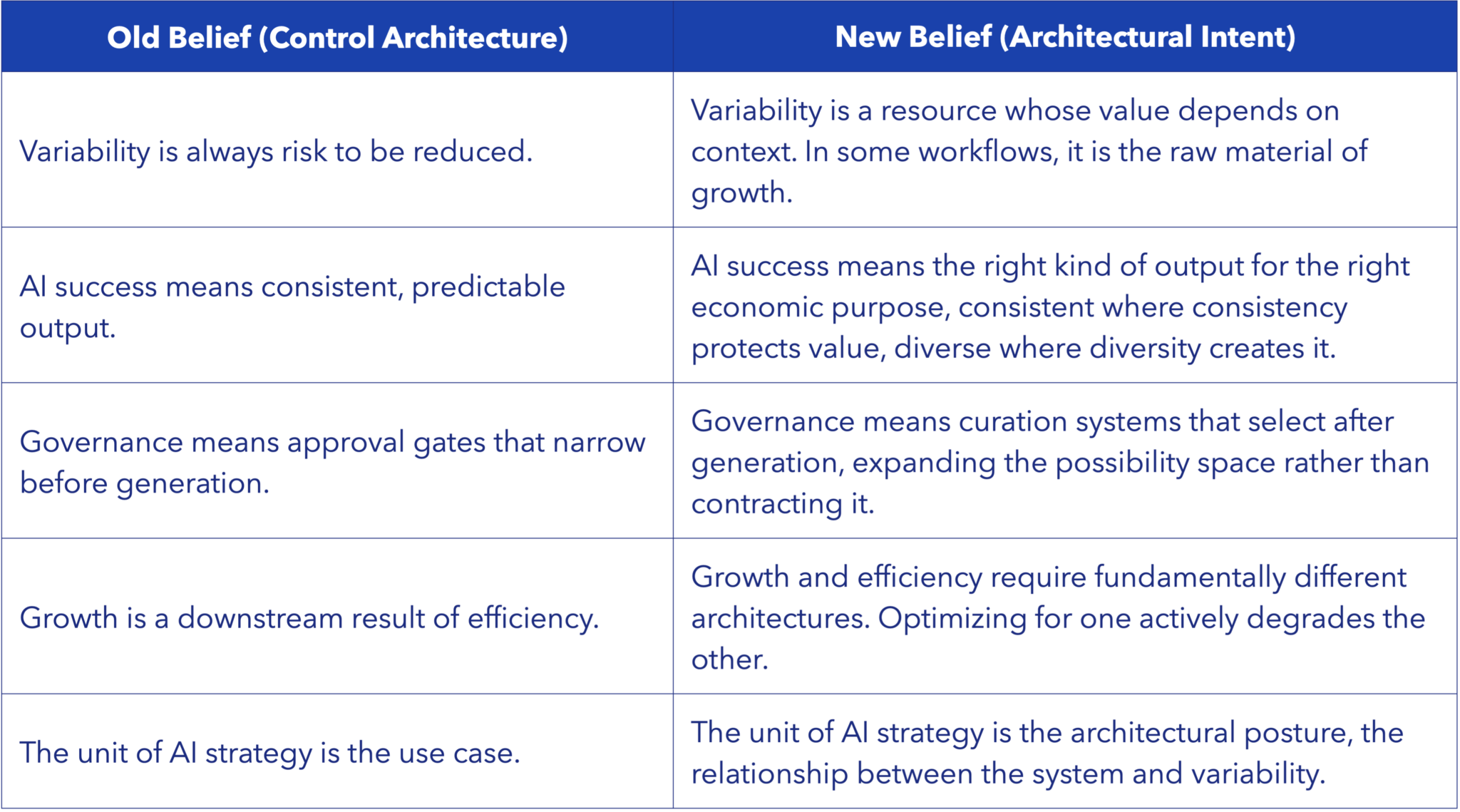
These are two fundamentally different ways of seeing AI’s role in the enterprise, so different they cannot be compared on the old terms. Leaders operating within the control architecture will evaluate these new beliefs using control metrics (consistency, predictability, error rates) and find them wanting. That resistance is not a flaw in the argument. It is the old assumptions doing exactly what they were built to do: making alternatives invisible.
Three strategic postures for AI architecture
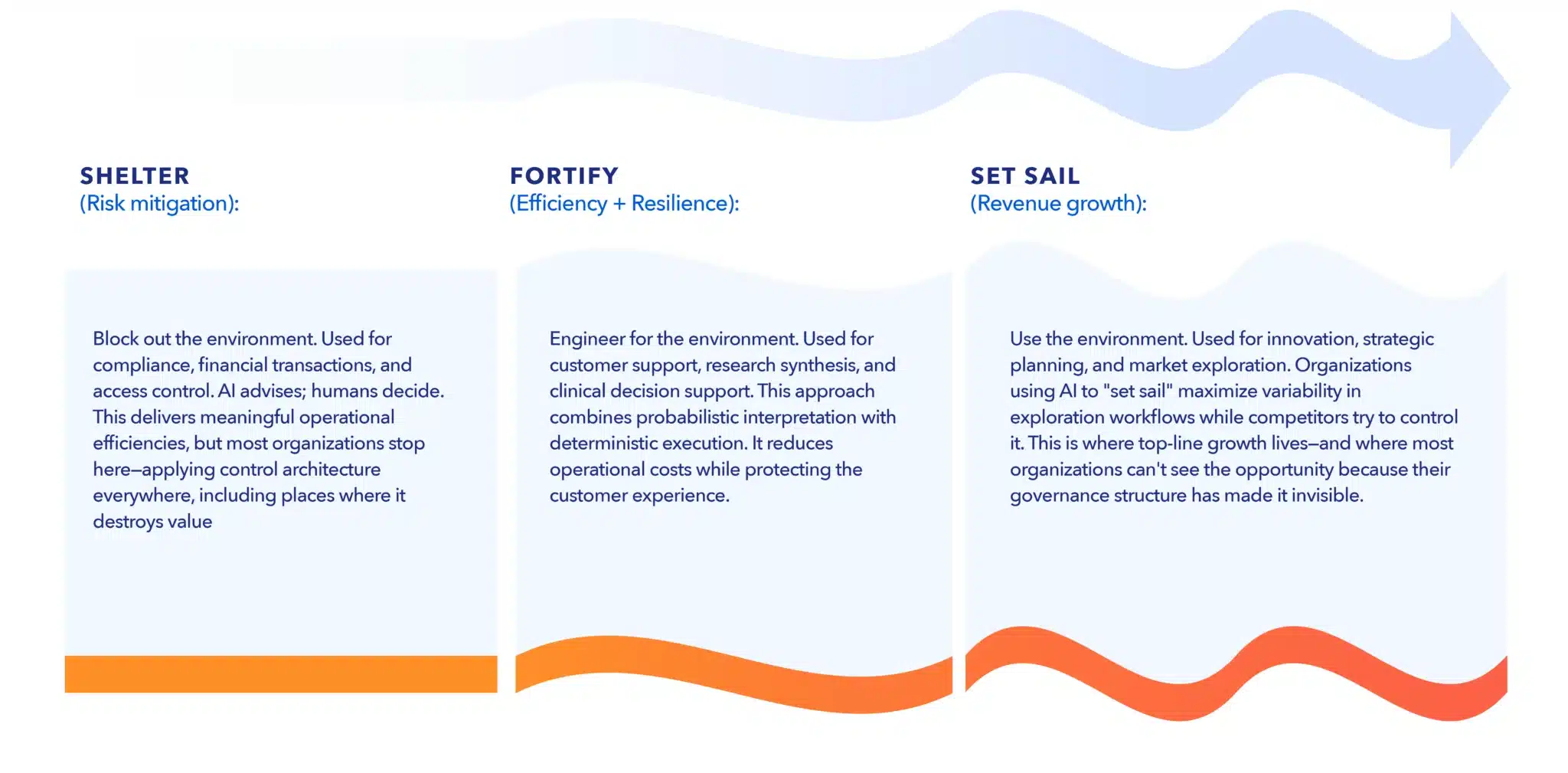
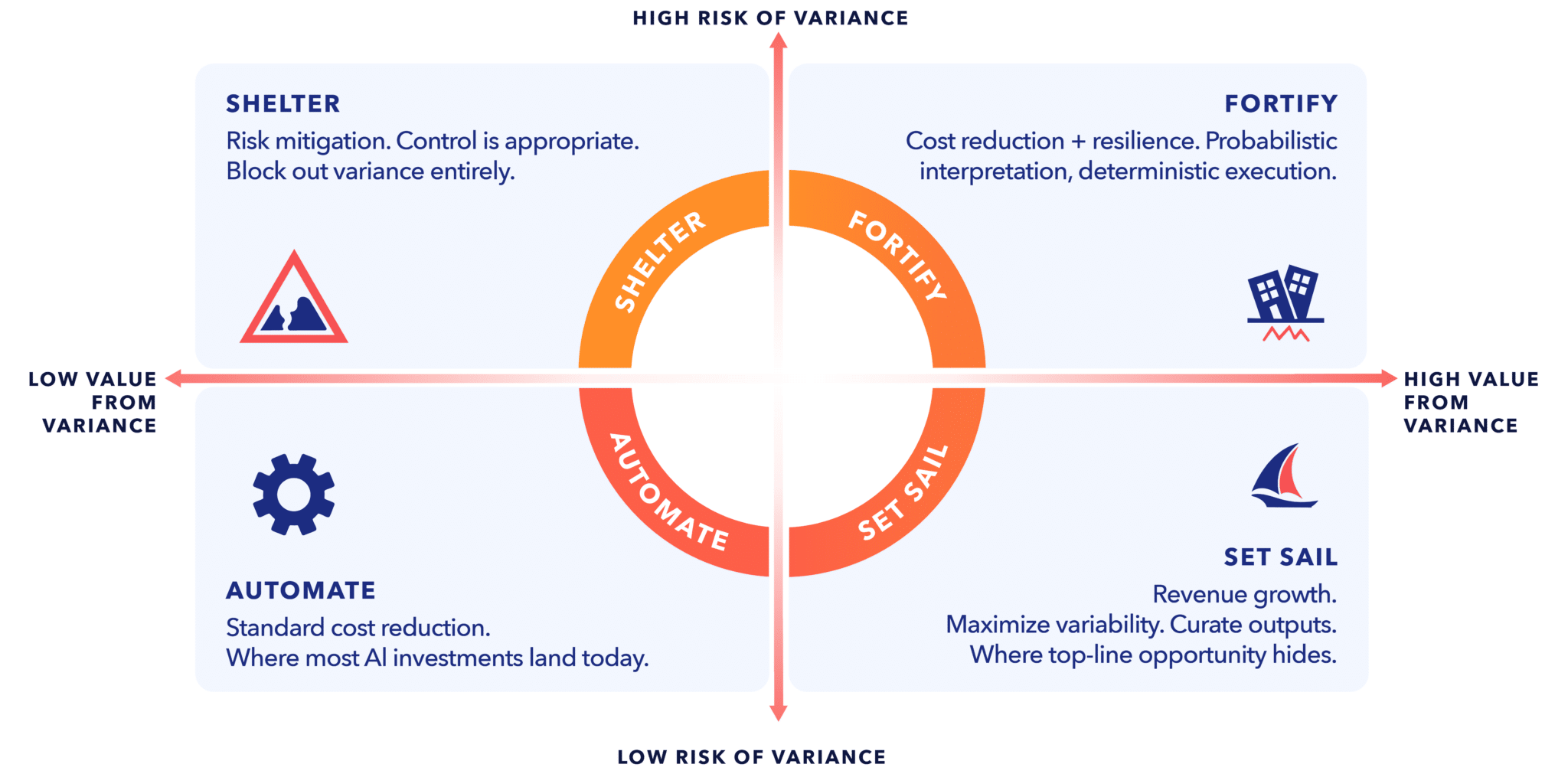
Humanity manages the forces of nature through three distinct relationships. We build shelters to block out the environment. We engineer structures to withstand it. We rig sails to use them for movement. Each maps to how enterprises should architect AI for different economic outcomes and the critical insight is that each requires a different relationship with variability, not a different degree of the same relationship.
Shelter: Block out the environment
Risk mitigation. Used for compliance, financial transactions, and access control. AI advises; humans decide. This delivers meaningful operational efficiencies, but most organizations stop here—applying shelter architecture everywhere, including places where it destroys value. This is the default mode: reliable, methodical, and incapable of producing novelty by design.
Fortify: Engineer for the environment
Efficiency and resilience. Used for customer support, research synthesis, and clinical decision support. This approach combines probabilistic interpretation with deterministic execution. It reduces operational costs while protecting the customer experience. This posture accepts that the environment is a variable but engineers for predictable outcomes within that variability.
Set Sail: Use the environment
Revenue growth. Used for innovation, strategic planning, and market exploration. This is where organizations maximize variability in exploration workflows while competitors try to control it. This is where top-line growth lives, and where most organizations can’t see the opportunity because their governance structure has made it invisible.
The strategic art is not choosing between shelter and sail. It is building an organization that holds both simultaneously—the productive tension between discipline and exploration that separates sophisticated strategy from simple optimization.
Shelter and Sail are not stages. They are simultaneous architectural needs. An organization needs control in its compliance workflows at the exact same moment it needs exploration in its market strategy workflows. The failure is not insufficient maturity. The failure is applying a single architectural posture to fundamentally different economic contexts.
What “Set Sail” architecture looks like for growth
The standard advice is to “shift AI from efficiency to growth” without explaining the architectural implications. That’s like telling a captain to “cross the ocean instead of hiding in the harbor” without explaining how to rig the ship. “Set Sail” architecture for AI requires three design inversions that directly contradict current best practices:
Inversion 1: From Minimizing Variance to Maximizing It
Traditional innovation generates 20 concepts per cycle, bounded by human cognitive constraints. AI systems at high temperature (0.8–1.0) generate hundreds, exploring adjacent markets and non-obvious combinations human teams systematically miss. The marginal cost of each additional concept approaches zero. Yet most organizations still set temperature to 0.3, optimizing for consistency when they should be architecting for exploration.
Variance is not noise. In growth contexts, variance is signal. The organization that generates 800 product concepts and curates the best 20 occupies a fundamentally different strategic position than one that generates 20 carefully controlled concepts. This is not the same strategy executed faster. It is a different strategy, one the control architecture literally cannot conceive.
Inversion 2: From Predicting One Future to Positioning for Many
Traditional forecasting predicts the single “most likely” future. We optimize strategies for that prediction, which is why we are caught flat-footed when markets shift. “Set Sail” architecture generates maximally diverse plausible futures, then stress-tests strategies across all scenarios. We are not trying to predict; we are positioning for multiple possibilities. When market conditions shift, we are already prepared while competitors scramble.
This changes the question entirely from “which future is most likely?” to “how do we remain viable across the widest range of futures?” The old architecture cannot even evaluate this approach because it measures success by prediction accuracy. Asking “how accurate is your forecast?” is the wrong question when the strategy is designed to be robust across many forecasts.
Inversion 3: From Approval Gates to Curation Systems
The key blocker to growth is the “approval gate,” a bottleneck that narrows outputs before generation. “Set Sail” architecture replaces gates with curation systems. We generate diverse outputs first, then use AI-augmented filtering to help humans select from portfolios. This allows organizations to handle larger volumes of ideas and explore significantly broader possibility spaces.
The unit of quality changes. In the control architecture, quality means “the right answer.” In growth architecture, quality means “the best selection from the widest field of possibilities.” This shift changes not just how we evaluate AI output but what we consider valuable in the first place: the definition of good work, the skills we hire for, and the governance structures we build.
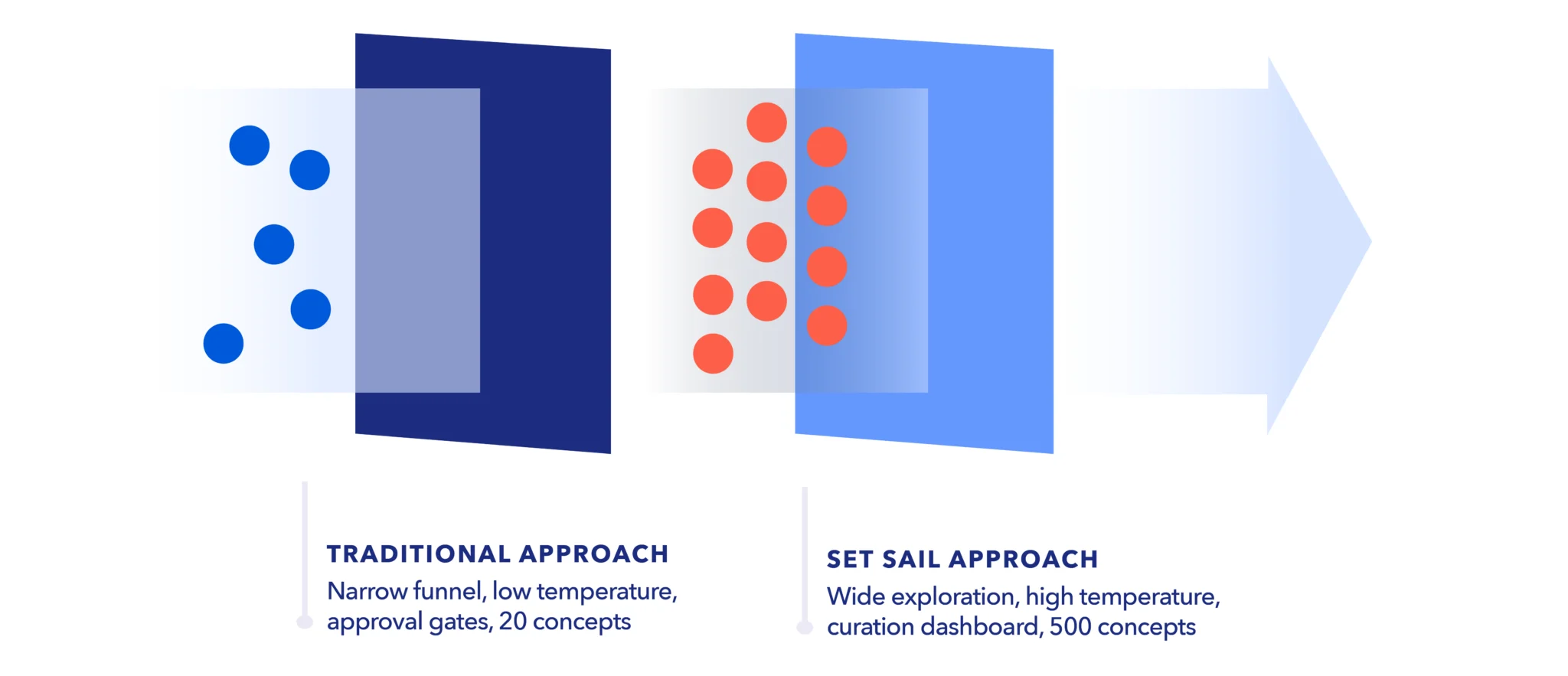
The common principle: Variability opens new revenue opportunities. Consistency means exploring fewer markets, testing fewer concepts, and reaching fewer customer segments. You’re not just getting the “right” answer faster, you’re discovering answers you wouldn’t have found at all.
The decision framework: An architectural diagnostic
Two dimensions determine which posture fits each workflow:
- Risk of Variance: What happens if outputs differ across runs? Is variance cheap and recoverable, or does it create liability?
- Value from Variance: Does diversity in outputs create value, or is consistency the goal?
The second dimension is actually asking: “Where do we create new revenue versus where do we reduce costs?” This creates four strategic territories with different economic outcomes.
The growth test
For any AI workflow, ask: “If we made this perfectly consistent and deterministic, would we be giving up potential revenue growth?”
If the answer is no because the goal is safety or cost efficiency, then optimize for control. Build a shelter. The industry’s obsession with control makes sense here.
If the answer is yes because consistency means exploring fewer markets, testing fewer concepts, discovering fewer opportunities, then your current architecture is destroying growth potential. You are building storm shelters in territory that demands open sails.
Warning signs that your assumptions are doing the thinking:
- Your innovation team measures AI success by consistency metrics.
- Your new product team is reducing “hallucinations” in market exploration.
- Your strategy team sets temperature to zero for scenario generation.
- Your governance framework applies the same review process to compliance filings and creative briefs.
- Leaders evaluate AI investment by asking “how reliable is it?” but never “how much territory does it explore?”
Each of these is evidence of assumption-locked thinking, applying control metrics to problems that require growth architectures. The metrics themselves make the problem invisible, which is precisely how deeply embedded assumptions maintain their grip.
What leaders actually need to hold
The most underappreciated insight in strategy is not about choosing between discipline and exploration. It is about the productive tension between them. The best organizations are those that can hold both simultaneously, deeply committed to operational rigor while remaining alert to the signals that their current approach has blind spots.
The most sophisticated AI strategy asks four questions:
- Where do we need to shelter? (Risk mitigation, block out variability to protect value)
- Where do we need to fortify? (Resilience, engineer for variability to protect the experience)
- Where do we need to set sail? (Revenue growth, use variability to discover new territory)
- Where are we building storm shelters when we should be setting sail? (The fourth question most organizations are not asking)
The strategic error is not that organizations cannot control AI variability. They are controlling it everywhere, including places where variability could drive top-line growth, and then wondering why their AI strategy delivers only bottom-line impact.
The architecture is the strategy
You cannot predict the weather. But you can decide whether your architecture is built to hide from it, withstand it, or use it.
The shift is not about adopting a new framework. It is about recognizing that the assumptions behind your current framework are structurally incapable of producing the outcome you want. Every firm in the industry can help you build better storm shelters. The question worth asking is whether storm shelters are what you need.
If you see the pattern, high AI investment and leadership talking about growth, but architectural decisions still optimized for efficiency, we can help you map where your organization might be building storm shelters in open ocean territory. This typically reveals opportunities that existing governance structures have made invisible. We would welcome the conversation.