












Intelligent Enterprises start with outcomes, not tools
AI is accelerating faster than most organizations can absorb. New tools appear every week, but leaders are still wrestling with the same questions: Where will this actually move the needle for our business? How do we invest without chasing every shiny object?
Pariveda’s Intelligent Enterprise (IE) framework gives organizations a way to navigate those questions. At its core, an Intelligent Enterprise combines human and artificial intelligence to empower its people, drive innovation, and realize transformational outcomes. It is less about deploying a specific technology and more about intentionally shaping how intelligence flows through the organization.
In an Intelligent Enterprise, outcomes, capabilities, and platforms provide a simple way to align AI investments with what really matters.
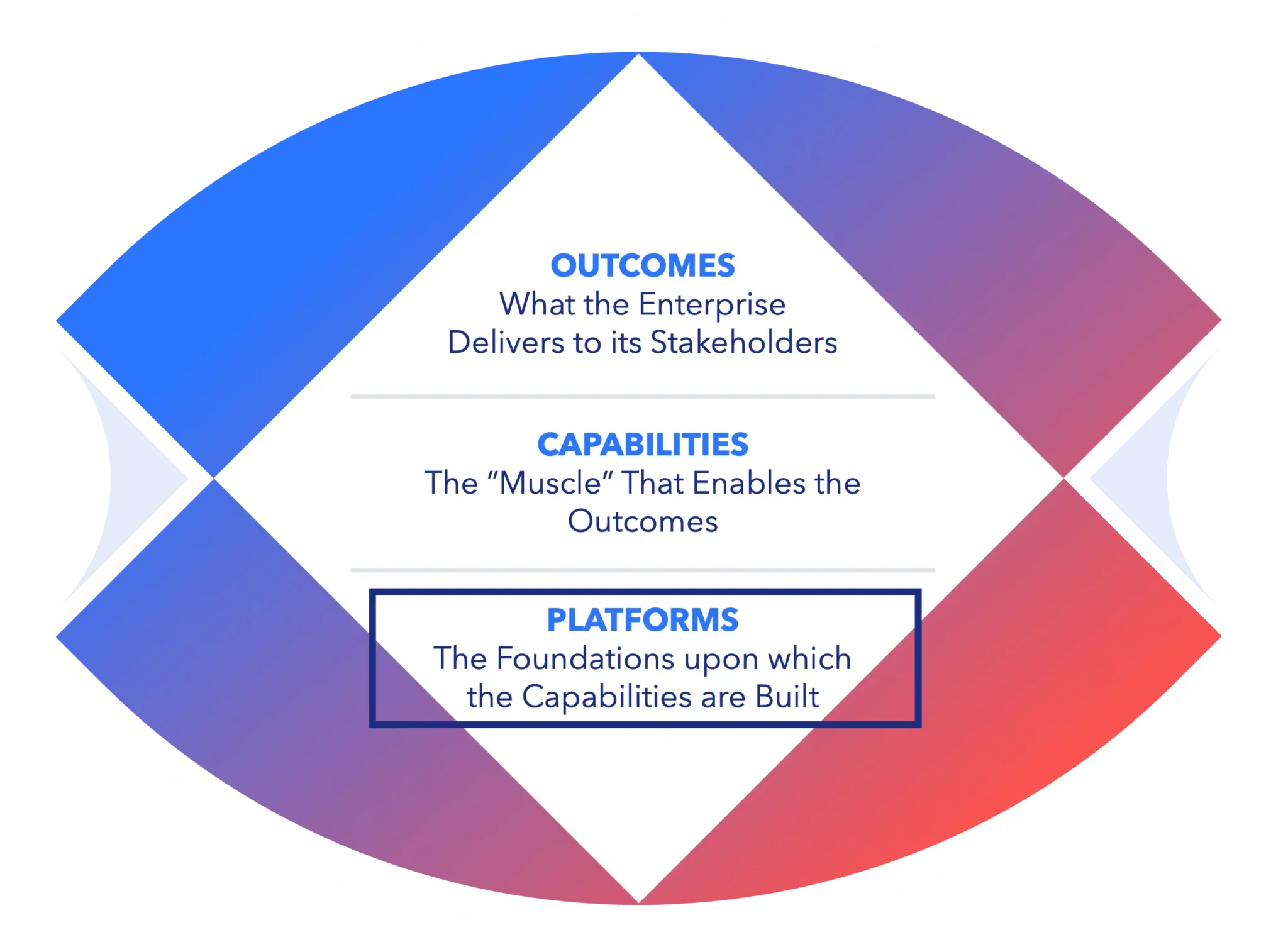
Outcomes – what the enterprise delivers to stakeholders
The tangible results you’re trying to improve, such as personalized customer experiences, faster decisions, proactive service delivery, or innovative products and services.
Capabilities – the “muscle” that enables those outcomes
The repeatable ways your organization learns and acts, like AI fluency across roles, AI-first product design, and AI-integrated process orchestration.
Platforms – the foundation upon which capabilities are built
The data and AI foundations that make those capabilities possible, including a unified data and intelligence layer, trustworthy data and AI governance, AI/ML/LLM operations, and integration for agents and applications.
In this article, we will focus on the Intelligent Enterprise’s platforms. Even as many organizations have spent millions investing in modern, cloud-native data platforms, most still feel a gap between the potential of their data and the reality of decision-making on the ground.
The Information Funnel – and why it leaks
Most enterprises don’t suffer from a lack of data. They suffer from information loss — valuable signals failing to make it all the way from the point of origin to the moment of decision.
We use the Information Funnel to describe this journey: the mechanisms through which an organization converts available information into informed action.
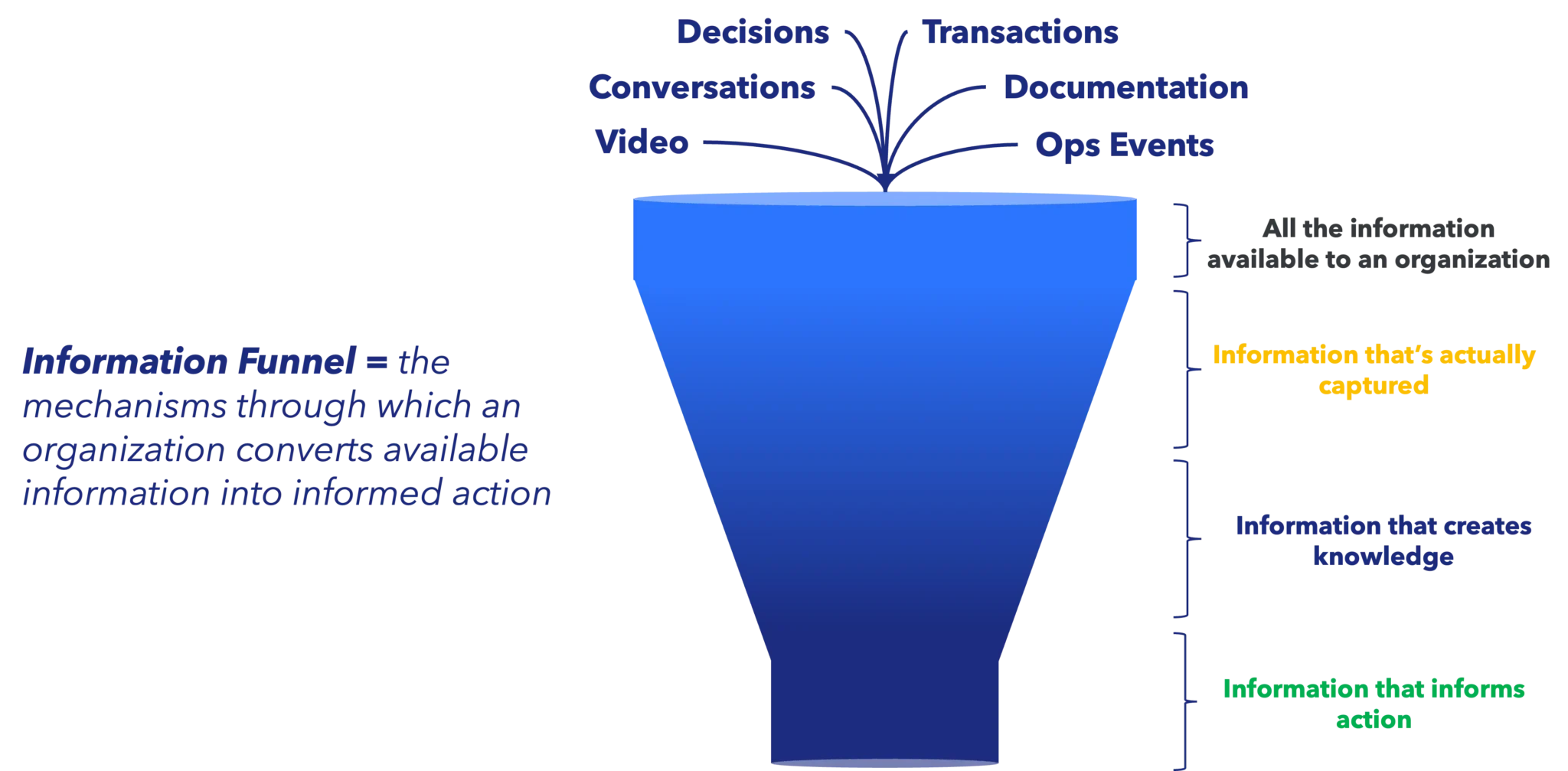
At the top of the funnel, every organization is awash in signals:
- Transactions and operational events
- Customer conversations, chats, and calls
- Internal discussions, emails, and meetings
- Documentation, tickets, and process artifacts
- Images, video, and sensor streams
In an ideal world, those signals would be captured, turned into knowledge, and then applied to decisions and actions. In reality, organizations experience a funnel that is lossy and ripe with friction.
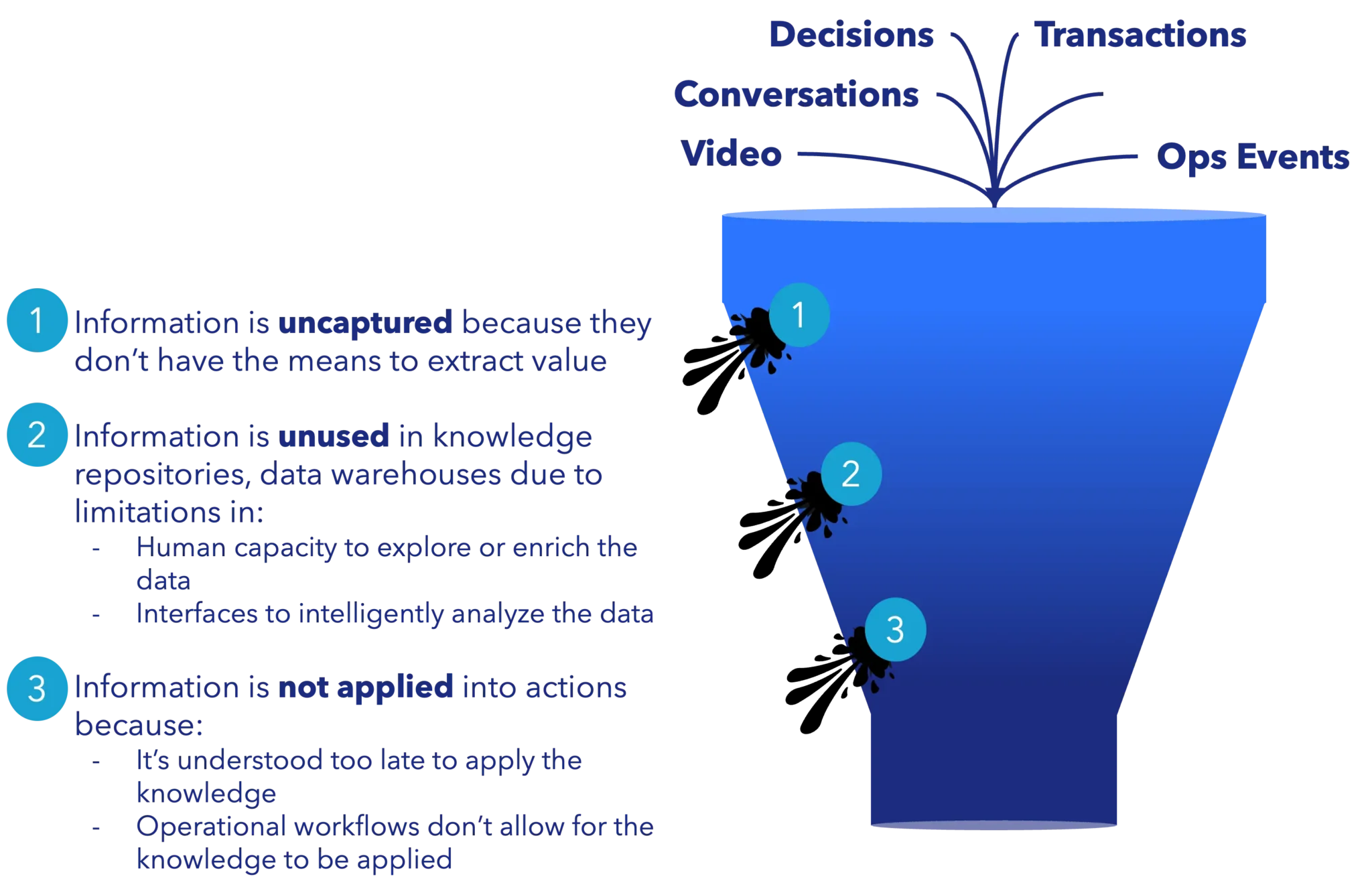
Despite many advancements made through the evolution of data platforms (detailed here), in many/all organizations today, information leaks out in three ways:
1. Uncaptured information
- Much of what happens in an enterprise never makes it into a system in a usable way.
- Nuance in a customer conversation, reasoning behind a decision, observations from the field, and the context of a meeting often stay in people’s heads or in ephemeral channels.
- Unstructured sources — free-form text, documents, images, audio, video — have been particularly under-harvested because traditional tooling struggled to extract their value.
2. Unused information
- Even when data is technically captured in systems, it often sits idle.
- Knowledge bases, document repositories, and data lakes accumulate content faster than humans can read, tag, or analyze it.
- Analysts and domain experts are a scarce resource; they can’t explore every dataset or manually join context across silos.
- Interfaces to this information have historically been optimized for specialists, not for everyday decision-makers.
3. Information not applied to action
- Insights that are produced frequently arrive too late or in the wrong form to influence decisions.
- Dashboards exist, but they’re disconnected from operational workflows.
- Recommendations are emailed instead of embedded in systems where work happens.
- By the time a team sees the signal, the opportunity has passed, or the cost has already been incurred.
The result: only a thin stream of the organization’s potential intelligence makes it through the funnel to influence real-world outcomes.
Accelerating the Information Funnel with AI
Advances in AI give us a new paradigm for how information moves through the funnel. Instead of accepting leaks as inevitable, we can use AI to capture more, understand more, and apply more of the signals our organizations already generate.

Capture & refine: reducing the “uncaptured” leak
Modern AI makes it practical to capture and refine information that used to slip through the cracks.
Conversations can be transcribed and summarized, documents auto-tagged, images and videos interpreted, and events stitched together across systems — without asking people to do more manual data entry.
What was once ephemeral or “too unstructured” becomes searchable, linkable, and ready for reuse.
Discover & analyze: turning dormant data into working knowledge
AI can also attack the “unused” leak by transforming how we discover and analyze information.
Natural language search, chat-based interfaces, and retrieval-augmented generation let people ask questions in their own words and pull back context from across data warehouses, document stores, and applications.
Dynamic summarization and pattern detection help teams see what matters without reading everything, making self-service insight a reality for far more roles.
Act: embedding intelligence where work happens:
The final leak — information not applied — requires bringing AI into the moment of action.
Agentic AI can watch for relevant signals, recommend next best actions, draft responses, or even initiate workflows, all inside the tools where people already work.
Instead of sending insights to dashboards and hoping someone looks at them, we embed intelligence in CRM screens, operations consoles, and line-of-business apps, so information actually changes decisions and behaviors.
The opportunity of the day: Broadening what we consider “valuable”
When AI can capture, understand, and act on rich, unstructured signals, our definition of “valuable data” expands.
Design files, call transcripts, maintenance logs, field photos, and free-form notes stop being exhaust and start becoming fuel for better outcomes. For Intelligent Enterprises, the opportunity is to intentionally redesign their information funnels — pairing AI capabilities with the right platforms and governance — so far more of their available information survives the journey from raw signal to informed action.
The Intelligent Enterprise’s platforms
We are expanding on the traditional, technology-focused use of “platform” to capture the key foundational elements that comprise the information sources for an Intelligent Enterprise. In other words, “platforms” are the mechanisms that shape the information funnel and how information flows through it. Capturing leaky information requires a broader, more robust approach where AI is an integral part of the ecosystem, rather than merely serving as a data consumer.
When correctly integrated, AI transitions traditional descriptive-to-prescriptive platforms to cognitive co-intelligence platforms, evolving data consumers into decision engineers. Put simply, decision engineering shifts the focus from figuring out what the data means to deciding what to do because of it. This is the foundation of an Intelligent Enterprise.
There are five key platforms within the Intelligent Enterprise, and we’ll briefly explore each:
- Data & AI Governance
- Enterprise Data Platform
- AI / ML / LLM Ops
- Agentic Platforms and Execution
- Unified Intelligence Catalog
Data & AI Governance
Trust begins with governance. The Intelligent Enterprise relies on insights and models that are traceable, verifiable, and ethical. Governance sets the policies and controls for lineage, privacy, bias detection, and responsible use. Modern governance introduces AI guardrails to verify model behavior and promote fairness. This platform safeguards innovation without sacrificing compliance or reputation.
Enterprise Data Platform
This is the foundation of intelligence; it unifies structured and unstructured data at scale through traditional and AI-enabled storage mechanisms. It establishes a governed source of truth and allows users to “converse with the data” using natural language. By treating data, models, and compute equally, it enables real-time insights, self-service discovery, and cross-enterprise context.
AI / ML / LLM Operations (Ops)
With data in place, intelligence is engineered. This platform trains, fine-tunes, deploys, and monitors models at scale—making each one observable and dependable. Standardized pipelines and catalogs transform experimentation into production, building a dynamic ecosystem of reusable, enterprise-ready AI capabilities. This is the platform that achieves enterprise scale.
Agentic Platforms and Execution
Here, insight turns into action. Agentic Platforms orchestrate AI agents that automate workflows and execute tasks across systems using protocols like MCP. Instead of dashboards suggesting action, these agents take it—boosting decision velocity and operational efficiency. This is where we see co-intelligence and human-AI partnership flourish.
Unified Intelligence Catalog
The connective tissue of the Intelligent Enterprise, this catalog links all platforms into a unified, semantic layer. It maps relationships among data, models, agents, and tools, enabling people and machines to find, understand, and act on knowledge in context—the result: faster, collaborative decision-making and reusable intelligence. Thanks to the semantic capabilities, we also move toward proactive information surfacing, where the platforms work together to push rather than wait for searches and pulls.
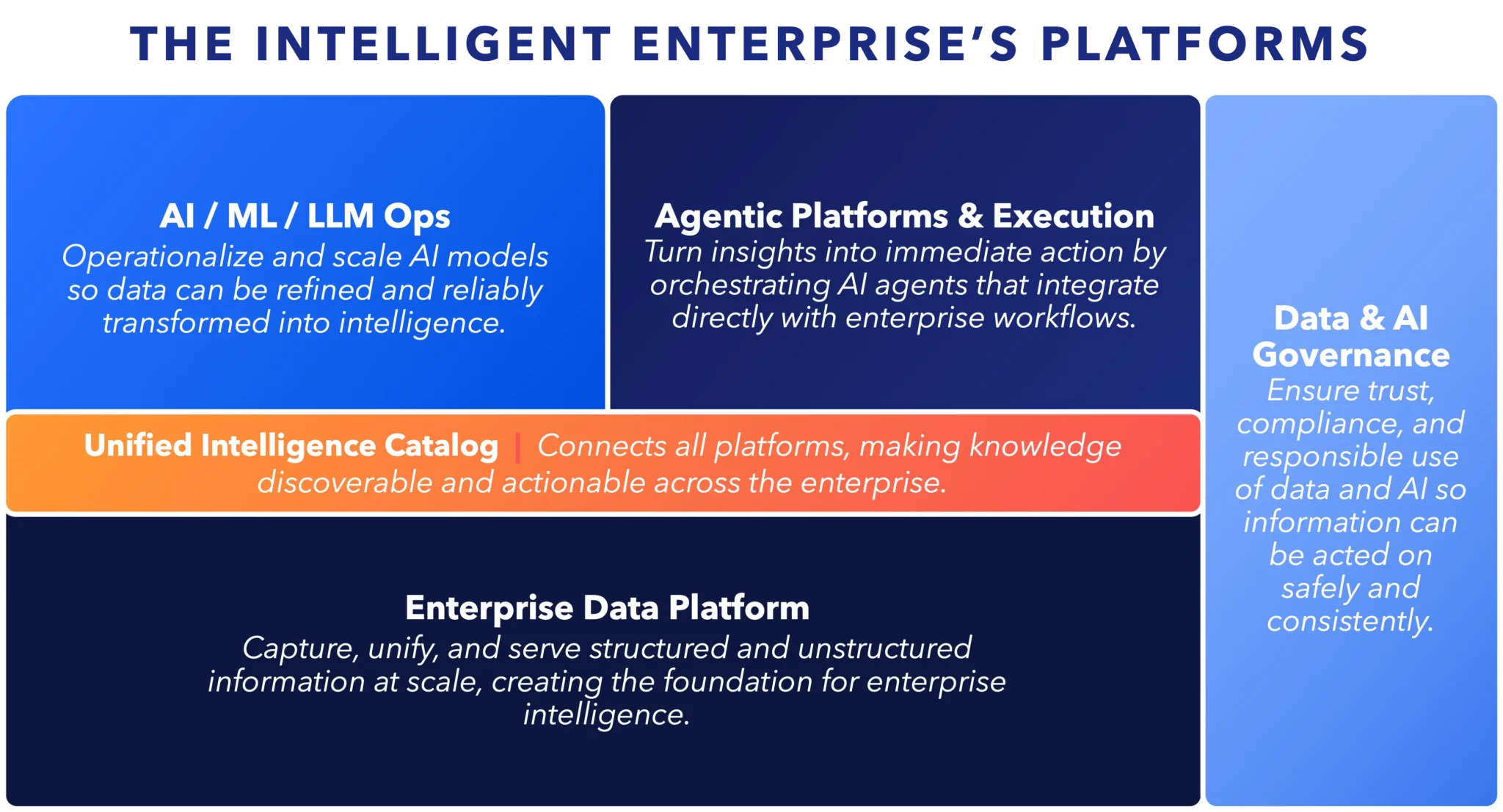
Platforms serve as the foundation for building enterprise capabilities. They supply reliable data, scalable intelligence, and automated processes that enable functions like forecasting, optimization, personalization, and decision engineering. In turn, these capabilities help organizations achieve their strategic outcomes—faster decision-making, greater efficiency, increased profits, social impact, and differentiated customer value. Essentially, platforms drive capabilities, and capabilities produce outcomes; without the foundation, the outcomes cannot exist or be sustained.
A use case to bring IE’s platform concepts to reality
Pariveda partnered with a leading global manufacturer to develop the foundational platforms necessary for evolving into an Intelligent Enterprise. By modernizing their data environment and introducing AI/ML Ops, agentic execution, and a unified intelligence catalog, the company created an ecosystem where insights seamlessly trigger action. The results were significant: more than 400 ML models, 100+ data products, and 30 production-grade generative AI use cases now power decisions across supply chain, design, and customer operations. AI surfaced millions in savings opportunities, manufacturing automation reclaimed thousands of hours, and customer service responses became three times faster through AI-driven copilots. Through this work, the organization developed nearly all core capabilities of an Intelligent Enterprise—trusted data, scalable intelligence, and automated execution—demonstrating how strong platforms translate directly into measurable business outcomes.
In conclusion…
The manufacturer’s transformation illustrates what becomes possible when platforms, capabilities, and outcomes align—but it also serves as a reminder that reaching this level of Intelligent Enterprise doesn’t happen by chance. It’s the result of intentional choices about where to invest, how to modernize, and which barriers to remove so information can flow “leakage-free” from insight to action. With that in mind, there are a few guiding principles every leader should consider as they forge their own path toward an Intelligent Enterprise.
- Start with the value levers that matter — anchor your efforts in right-to-left thinking: build for the outcomes you need now, not the hypothetical ones you might need someday. Let those priorities guide your platform decisions and investments.
- Lean into platforms — capabilities only scale when the foundation is intentionally built. Building on point one, leverage the value you wish to create to understand the platform foundation your organization needs.
- Design for action, not analytics — intelligence matters only when it moves the business forward. Strive for decision engineering, not deciding where to look next.
- Govern early and often — trust is the multiplier that unlocks enterprise-wide adoption and scale. Governance should amplify intelligence, not restrict it.
Now is the moment to reassess your ecosystem, identify the leaks in your information funnel, and prioritize the platform investments that will unlock decision velocity.
Intelligent Enterprises aren’t born—they’re engineered. Build the right platforms, develop the right capabilities, and the outcomes will follow. If you want to learn more about how to transform your organization into an Intelligent Enterprise, get in touch with our Intelligence Enterprise team here.